Economy
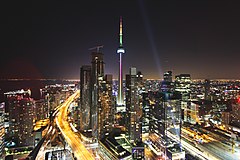
Canada is the world's tenth-largest economy as of 2018update, with a nominal GDP of approximately US$1.73 trillion. It is one of the least corrupt countries in the world, and is one of the world's top ten trading nations, with a highly globalized economy. Canada has a mixed economy ranking above the U.S. and most western European nations on The Heritage Foundation's Index of Economic Freedom, and experiencing a relatively low level of income disparity. The country's average household disposable income per capita is "well above" the OECD average. The Toronto Stock Exchange is the ninth-largest stock exchange in the world by market capitalization, listing over 1,500 companies with a combined market capitalization of over US$2 trillion.
In 2018, Canadian trade in goods and services reached CA$1.5 trillion. Canada's exports totalled over CA$585 billion, while its imported goods were worth over CA$607 billion, of which approximately CA$391 billion originated from the United States, CA$216 billion from non-U.S. sources. In 2018, Canada had a trade deficit in goods of CA$22 billion and a trade deficit in services of CA$25 billion.
Since the early 20th century, the growth of Canada's manufacturing, mining, and service sectors has transformed the nation from a largely rural economy to an urbanized, industrial one. Like many other developed countries, the Canadian economy is dominated by the service industry, which employs about three-quarters of the country's workforce. However, Canada is unusual among developed countries in the importance of its primary sector, in which the forestry and petroleum industries are two of the most prominent components.
Canada's economic integration with the United States has increased significantly since World War II. The Automotive Products Trade Agreement of 1965 opened Canada's borders to trade in the automobile manufacturing industry. In the 1970s, concerns over energy self-sufficiency and foreign ownership in the manufacturing sectors prompted Prime Minister Pierre Trudeau's Liberal government to enact the National Energy Program (NEP) and the Foreign Investment Review Agency (FIRA). In the 1980s, Prime Minister Brian Mulroney's Progressive Conservatives abolished the NEP and changed the name of FIRA to Investment Canada, to encourage foreign investment. The Canada – United States Free Trade Agreement (FTA) of 1988 eliminated tariffs between the two countries, while the North American Free Trade Agreement (NAFTA) expanded the free-trade zone to include Mexico in 1994 (later replaced by the Canada–United States–Mexico Agreement). Canada has a strong cooperative banking sector, with the world's highest per-capita membership in credit unions.
Canada is one of the few developed nations that are net exporters of energy. Atlantic Canada possesses vast offshore deposits of natural gas, and Alberta also hosts large oil and gas resources. The vastness of the Athabasca oil sands and other assets results in Canada having a 13 percent share of global oil reserves, comprising the world's third-largest share after Venezuela and Saudi Arabia. Canada is additionally one of the world's largest suppliers of agricultural products; the Canadian Prairies are one of the most important global producers of wheat, canola, and other grains. The federal Department of Natural Resources provides statistics regarding its major exports; the country is a leading exporter of zinc, uranium, gold, nickel, platinoids, aluminum, steel, iron ore, coking coal, lead, copper, molybdenum, cobalt, and cadmium. Many towns in northern Canada, where agriculture is difficult, are sustainable because of nearby mines or sources of timber. Canada also has a sizeable manufacturing sector centred in southern Ontario and Quebec, with automobiles and aeronautics representing particularly important industries.
Science and technology
In 2018, Canada spent approximately CA$34.5 billion on domestic research and development, of which around $7 billion was provided by the federal and provincial governments. As of 2018update, the country has produced fourteen Nobel laureates in physics, chemistry, and medicine, and was ranked fourth worldwide for scientific research quality in a major 2012 survey of international scientists. It is furthermore home to the headquarters of a number of global technology firms. Canada has one of the highest levels of Internet access in the world, with over 33 million users, equivalent to around 94 percent of its total 2014 population.
Some of the most notable scientific developments in Canada include the creation of the modern alkaline battery and the polio vaccine and discoveries about the interior structure of the atomic nucleus. Other major Canadian scientific contributions include the artificial cardiac pacemaker, mapping the visual cortex, the development of the electron microscope, plate tectonics, deep learning, multi-touch technology and the identification of the first black hole, Cygnus X-1. Canada has a long history of discovery in genetics, which include stem cells, site-directed mutagenesis, T-cell receptor and the identification of the genes that cause Fanconi anemia, cystic fibrosis and early-onset Alzheimer's disease, among numerous other diseases.
The Canadian Space Agency operates a highly active space program, conducting deep-space, planetary, and aviation research, and developing rockets and satellites. Canada was the third country to design and construct a satellite after the Soviet Union and the United States, with the 1962 Alouette 1 launch. Canada is a participant in the International Space Station (ISS), and is a pioneer in space robotics, having constructed the Canadarm, Canadarm2 and Dextre robotic manipulators for the ISS and NASA's Space Shuttle. Since the 1960s, Canada's aerospace industry has designed and built numerous marques of satellite, including Radarsat-1 and 2, ISIS and MOST. Canada has also produced one of the world's most successful and widely used sounding rockets, the Black Brant; over 1,000 Black Brants have been launched since the rocket's introduction in 1961.


Comments
Post a Comment