Demographics
The 2016 Canadian Census enumerated a total population of 35,151,728, an increase of around 5.0 percent over the 2011 figure. Between 2011 and May 2016, Canada's population grew by 1.7 million people, with immigrants accounting for two-thirds of the increase. Between 1990 and 2008, the population increased by 5.6 million, equivalent to 20.4 percent overall growth. The main drivers of population growth are immigration and, to a lesser extent, natural growth.
Canada has one of the highest per-capita immigration rates in the world, driven mainly by economic policy and also family reunification. The Canadian public, as well as the major political parties, support the current level of immigration. In 2019, a total of 341,180 immigrants were admitted to Canada, mainly from Asia. India, Philippines and China are the top three countries of origin for immigrants moving to Canada. New immigrants settle mostly in major urban areas such as Toronto, Montreal and Vancouver. Canada also accepts large numbers of refugees, accounting for over 10 percent of annual global refugee resettlements.
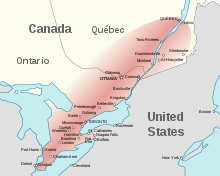
Canada's population density, at 3.7 inhabitants per square kilometre (9.6/sq mi), is among the lowest in the world. Canada spans latitudinally from the 83rd parallel north to the 41st parallel north, and approximately 95 percent of the population is found south of the 55th parallel north. About four-fifths of the population lives within 150 kilometres (93 mi) of the border with the contiguous United States. The most densely populated part of the country, accounting for nearly 50 percent, is the Quebec City–Windsor Corridor in Southern Quebec and Southern Ontario along the Great Lakes and the Saint Lawrence River. An additional 30 percent live along the British Columbia Lower Mainland and the Calgary–Edmonton Corridor in Alberta.
The majority of Canadians (69.9 percent) live in family households, 26.8 percent report living alone, and those living with unrelated persons reported at 3.7 percent. The average size of a household in 2006 was 2.5 people.
Largest census metropolitan areas in Canada by population (2016 census)
| ||||||
|---|---|---|---|---|---|---|
| CMA | Province | Population | CMA | Province | Population | |
| Toronto | Ontario | 5,928,040 | London | Ontario | 494,069 | |
| Montreal | Quebec | 4,098,927 | St. Catharines–Niagara | Ontario | 406,074 | |
| Vancouver | British Columbia | 2,463,431 | Halifax | Nova Scotia | 403,390 | |
| Calgary | Alberta | 1,392,609 | Oshawa | Ontario | 379,848 | |
| Ottawa–Gatineau | Ontario–Quebec | 1,323,783 | Victoria | British Columbia | 367,770 | |
| Edmonton | Alberta | 1,321,426 | Windsor | Ontario | 329,144 | |
| Quebec | Quebec | 800,296 | Saskatoon | Saskatchewan | 295,095 | |
| Winnipeg | Manitoba | 778,489 | Regina | Saskatchewan | 236,481 | |
| Hamilton | Ontario | 747,545 | Sherbrooke | Quebec | 212,105 | |
| Kitchener– Cambridge–Waterloo |
Ontario | 523,894 | St. John's | Newfoundland and Labrador | 205,955 | |
Health
Healthcare in Canada is delivered through the provincial and territorial systems of publicly funded health care, informally called Medicare. It is guided by the provisions of the Canada Health Act of 1984, and is universal. Universal access to publicly funded health services "is often considered by Canadians as a fundamental value that ensures national health care insurance for everyone wherever they live in the country." However, 30 percent of Canadians' healthcare is paid for through the private sector. This mostly goes towards services not covered or partially covered by Medicare, such as prescription drugs, dentistry and optometry. Approximately 65 to 75 percent of Canadians have some form of supplementary health insurance related to the aforementioned reasons; many receive it through their employers or utilizes secondary social service programs related to extended coverage for families receiving social assistance or vulnerable demographics, such as seniors, minors, and those with disabilities.
In common with many other developed countries, Canada is experiencing a cost increase due to a demographic shift towards an older population, with more retirees and fewer people of working age. In 2006, the average age was 39.5 years; within twelve years it had risen to 42.4 years, with a life expectancy of 81.1 years. A 2016 report by the chief public health officer of Canada found that 88 percent of Canadians; one of the highest proportions of the population among G7 countries, indicated that they "had good or very good health". 80 percent of Canadian adults self-report having at least one major risk factor for chronic disease; smoking, physical inactivity, unhealthy eating or excessive alcohol use. Canada has one of the highest rates of adult obesity among Organisation for Economic Co-operation and Development (OECD) countries attributing to approximately 2.7 million cases of diabetes (types 1 and 2 combined). Four chronic diseases; cancer (leading cause of death), cardiovascular diseases, respiratory diseases and diabetes account for 65 percent of deaths in Canada.
In 2017, the Canadian Institute for Health Information reported that healthcare spending reached $242 billion, or 11.5 percent of Canada's gross domestic product (GDP) for that year. Canada's per-capita spending ranks as seventh on the list of countries by total health expenditure per capita in the OECD and above the average of 8.8 percent of GDP. Canada has performed close to, or above the average on the majority of OECD health indicators since the early 2000s. In 2017 Canada ranked above the average on OECD indicators for wait-times and access to care, with average scores for quality of care and use of resources. A comprehensive study from 2017 of the top 11 countries ranked Canada's health care system third-to-last. Identified weaknesses of Canada's system were comparatively higher infant mortality rate, the prevalence of chronic conditions, long wait times, poor availability of after-hours care, and a lack of prescription drugs and dental coverage.
Education
Education in Canada is for the most part provided publicly, funded and overseen by federal, provincial, and local governments. Education is within provincial jurisdiction and the curriculum is overseen by the province. Education in Canada is generally divided into primary education, followed by secondary education and post-secondary. Education in both English and French is available in most places across Canada. Canadian provinces and territories are responsible for education provision. Canada has a large number of Universities, almost all of which are publicly funded. Established in 1663, Université Laval is the oldest post-secondary institution in Canada. The largest University is the University of Toronto with over 85,000 students. Four Universities are regularly ranked among the top 100 world-wide, namely University of Toronto, University of British Columbia, McGill University and McMaster University, with a total of 18 Universities ranked in the top 500 worldwide.
According to a 2019 report by the OECD, Canada is one of the most educated countries in the world; the country ranks first worldwide in the number of adults having tertiary education, with over 56 percent of Canadian adults having attained at least an undergraduate college or university degree. Canada spends about 5.3 percent of its GDP on education. The country invests heavily in tertiary education (more than US$20,000 per student). As of 2014update, 89 percent of adults aged 25 to 64 have earned the equivalent of a high-school degree, compared to an OECD average of 75 percent.
The mandatory school age ranges between 5–7 to 16–18 years, contributing to an adult literacy rate of 99 percent. In 2002, 43 percent of Canadians aged 25 to 64 possessed a post-secondary education; for those aged 25 to 34, the rate of post-secondary education reached 51 percent. The Programme for International Student Assessment indicates Canadian students perform well above the OECD average, particularly in mathematics, science, and reading, ranking the overall knowledge and skills of Canadian 15-year-olds as the sixth-best in the world. Canada is a well-performing OECD country in reading literacy, mathematics, and science with the average student scoring 523.7, compared with the OECD average of 493 in 2015.
Ethnicity
According to the 2016 Canadian Census, the country's largest self-reported ethnic origin is Canadian (accounting for 32 percent of the population),b followed by English (18.3 percent), Scottish (13.9 percent), French (13.6 percent), Irish (13.4 percent), German (9.6 percent), Chinese (5.1 percent), Italian (4.6 percent), First Nations (4.4 percent), Indian (4.0 percent), and Ukrainian (3.9 percent). There are 600 recognized First Nations governments or bands, encompassing a total of 1,525,565 people. The Indigenous population in Canada is growing at almost twice the national rate, and four percent of Canada's population claimed an Indigenous identity in 2006. Another 22.3 percent of the population belonged to a non-Indigenous visible minority. In 2016, the largest visible minority groups were South Asian (5.6 percent), Chinese (5.1 percent) and Black (3.5 percent). Between 2011 and 2016, the visible minority population rose by 18.4 percent. In 1961, less than two percent of Canada's population (about 300,000 people) were members of visible minority groups. Indigenous peoples are not considered a visible minority under the Employment Equity Act, and this is the definition that Statistics Canada also uses.
Languages
A multitude of languages are used by Canadians, with English and French (the official languages) being the mother tongues of approximately 56 percent and 21 percent of Canadians, respectively. As of the 2016 Census, just over 7.3 million Canadians listed a non-official language as their mother tongue. Some of the most common non-official first languages include Chinese (1,227,680 first-language speakers), Punjabi (501,680), Spanish (458,850), Tagalog (431,385), Arabic (419,895), German (384,040), and Italian (375,645). Canada's federal government practices official bilingualism, which is applied by the commissioner of Official Languages in consonance with Section 16 of the Canadian Charter of Rights and Freedoms and the federal Official Languages Act. English and French have equal status in federal courts, parliament, and in all federal institutions. Citizens have the right, where there is sufficient demand, to receive federal government services in either English or French and official-language minorities are guaranteed their own schools in all provinces and territories.
The 1977 Charter of the French Language established French as the official language of Quebec. Although more than 85 percent of French-speaking Canadians live in Quebec, there are substantial Francophone populations in New Brunswick, Alberta, and Manitoba; Ontario has the largest French-speaking population outside Quebec. New Brunswick, the only officially bilingual province, has a French-speaking Acadian minority constituting 33 percent of the population. There are also clusters of Acadians in southwestern Nova Scotia, on Cape Breton Island, and through central and western Prince Edward Island.
Other provinces have no official languages as such, but French is used as a language of instruction, in courts, and for other government services, in addition to English. Manitoba, Ontario, and Quebec allow for both English and French to be spoken in the provincial legislatures, and laws are enacted in both languages. In Ontario, French has some legal status, but is not fully co-official. There are 11 Indigenous language groups, composed of more than 65 distinct languages and dialects. Several Indigenous languages have official status in the Northwest Territories. Inuktitut is the majority language in Nunavut, and is one of three official languages in the territory.
Additionally, Canada is home to many sign languages, some of which are Indigenous. American Sign Language (ASL) is spoken across the country due to the prevalence of ASL in primary and secondary schools. Due to its historical relation to the francophone culture, Quebec Sign Language (LSQ) is spoken primarily in Quebec, although there are sizeable Francophone communities in New Brunswick, Ontario and Manitoba.
Religion
Canada is religiously diverse, encompassing a wide range of beliefs and customs. Canada has no official church, and the government is officially committed to religious pluralism. Freedom of religion in Canada is a constitutionally protected right, allowing individuals to assemble and worship without limitation or interference. The practice of religion is now generally considered a private matter throughout society and the state. With Christianity in decline after having once been central and integral to Canadian culture and daily life, Canada has become a post-Christian, secular state. The majority of Canadians consider religion to be unimportant in their daily lives, but still believe in God.
According to the 2011 National Household Survey, 67.3 percent of Canadians identify as Christian; of these, Roman Catholics make up the largest group, accounting for 38.7 percent of the population. Much of the remainder is made up of Protestants, who accounted for approximately 27 percent in a 2011 survey. The largest Protestant denomination is the United Church of Canada (accounting for 6.1 percent of Canadians), followed by the Anglican Church of Canada (5.0 percent), and various Baptist sects (1.9 percent). Secularization has been growing since the 1960s. In 2011, 23.9 percent declared no religious affiliation, compared to 16.5 percent in 2001. Islam is the largest non-Christian religion in Canada, constituting 3.2 percent of its population. It is also the fastest growing religion in Canada. 1.5 percent of the Canadian population is Hindu and 1.4 percent is Sikh.


Comments
Post a Comment